
Multi-Channel Content Creation: Implementation Process and Performance Measurement
Many businesses post consistently on Facebook, TikTok, Instagram, LinkedIn, and their website — yet the results rarely match the time, staff, and budget invested.
Content goes out every day, but the message differs from channel to channel. A blog post gets views but few visitors click through to the service page. A video gets engagement but doesn't spark the right kind of conversation. The website is full of content, yet customers still have to ask the same basic questions all over again.
The problem here usually isn't a lack of content. More often, the business is producing many disconnected posts without ever building a real multi-channel content system.
A proper system needs to answer:
- Which customer segment is this content serving?
- What stage of the buying journey are they in?
- What role does each channel play?
- What should the reader do after seeing this content?
- What data is the business using to evaluate results?
When these questions remain unanswered, simply publishing more rarely fixes the underlying issue.
What Is Multi-Channel Content Creation?
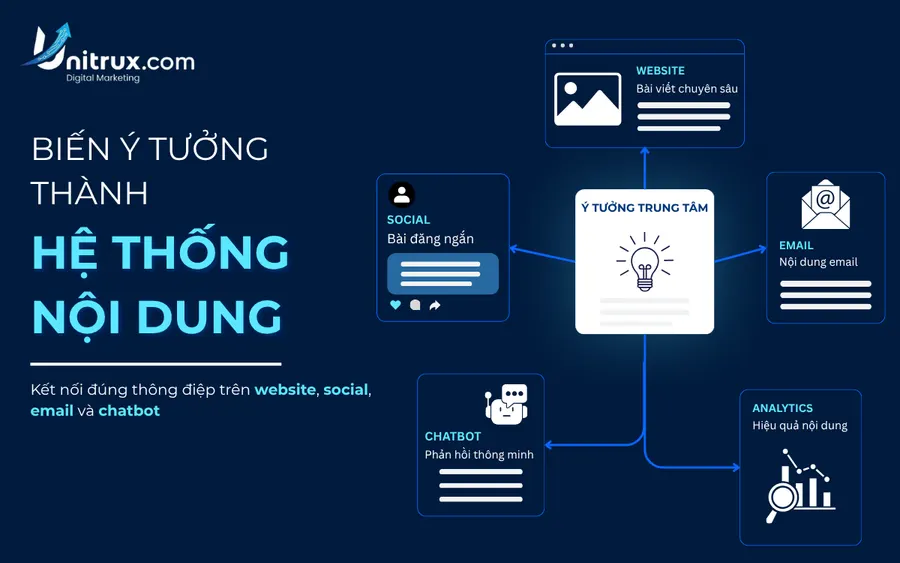
Multi-channel content creation is the process of researching, building, and distributing content across multiple platforms, all anchored to one unified messaging system.
Each channel can look and feel different, but the content needs to stay consistent on:
- Target customer segment
- The problem being solved
- Product or service information
- The value the business delivers
- Evidence and data used
- The next action for the reader
Multi-channel content creation is not copy-pasting one article verbatim across every platform.
For example, starting from the topic "why a website gets traffic but few visitors leave their contact information," a business could develop it into:
- An in-depth analysis on the website
- A short share-worthy post on Facebook
- A summary carousel on Instagram
- A short thread on Threads
- An explainer video on TikTok or Reels
- A business-angle analysis piece on LinkedIn
- An email to an interested customer segment
- A Q&A set for the chatbot or the consulting team
Each version solves the same underlying problem, adapted to user behavior on that specific platform.
Why Multi-Channel Content Matters More Than Ever
Customers rarely decide after a single blog post or ad. They see a brand on social media, search for more on Google, read the website, check reviews, message the business, and talk to a sales rep — all before making a decision.
According to McKinsey's 2026 Global B2B Pulse report, based on a survey of nearly 4,000 B2B decision-makers across 13 countries, buyers now use an average of about 10 touchpoints throughout their purchasing journey, and expect seamless transitions, consistent information, and access to expertise at every step. This is international B2B survey data and should be treated as a reference point — not a fixed number for every business or market.
A separate Salesforce study published in 2023 found that 79% of customers surveyed expect consistent interactions across departments. Yet 55% said their actual experience felt like dealing with separate departments rather than one unified company.
Neither data set proves that every business needs to be present on every platform. What they do show is a real risk: customers encounter a brand in many different places, and inconsistent information can make their research journey harder than it needs to be.
Signs a Business Doesn't Have a Multi-Channel Content System Yet
1. Every channel is saying something different
The website describes one set of services, the Facebook page pushes a different message, ads promise something else again, and sales reps explain things their own way.
Differences in tone or presentation are normal. But differences in pricing, service scope, policy, or expected outcomes make it hard for customers to evaluate information consistently.
2. Content is planned around volume, not purpose
Many content plans start with targets like:
- 20 posts a month
- 3 videos a week
- A social post every single day
- 4 SEO articles a month
These targets help manage workload, but they say nothing about what role each piece of content is actually playing in the customer journey, such as:
- Helping customers recognize a problem
- Explaining root causes
- Answering common questions
- Guiding customers to choose a solution
- Building trust through process or evidence
- Leading readers to deeper content
- Capturing consultation requests
- Helping the sales team explain the service
If a business only tracks how many posts got published, it's very hard to know whether content is actually supporting the customer journey.
3. Content has no clear next step
A piece of content can be useful but still leave the reader unsure what to do next:
- A social post doesn't link to deeper content
- A website article doesn't link to the relevant service page
- A video has no description or proper link
- A service page has no FAQ section
- A form asks for too much information upfront
- A customer messages in but has to re-explain their entire need
A CTA doesn't have to be "buy now" or "sign up now." Depending on the stage, it could be: read the detailed guide, check a related analysis, download a checklist, see an implementation example, compare options, send a question, or self-assess their current situation.
4. Content, the website, and the consulting team operate in silos
Marketing generates content and traffic, but the consulting team has no idea what content a customer has seen or what they're actually interested in. On the flip side, sales reps constantly hear real customer questions, but that information never makes it back into the content plan.
When data between content, the website, chatbot, and the consulting team isn't connected, the business struggles to know: which content attracts the right people, which questions come up repeatedly, where customers tend to drop off, what information is missing, and which channel is actually generating qualified leads.
5. Using AI before standardizing data
AI is genuinely useful for research, drafting, reformatting, and repurposing content. But it cannot independently verify that internal information is accurate if the input data itself hasn't been controlled.
According to the B2B Content and Marketing Trends: Insights for 2026 report from the Content Marketing Institute — a survey of 1,015 B2B marketers, mostly in North America, fielded between June 24 and August 14, 2025 — 95% said their organization uses AI-powered marketing tools, and 91% reported collecting first-party data. However, roughly half rated their first-party data strategy as still in the exploratory or developing stage, well short of mature.
These figures don't represent every business in Vietnam, but they point to a notable trend: the pace of AI tool adoption is outrunning the pace of building proper data governance. If information about products, pricing, policy, and customers hasn't been standardized, speeding up production with AI can actually increase the risk of inconsistent or inaccurate content.
Why Multi-Channel Content Often Underperforms
1. The target customer segment isn't clearly defined. A business may serve multiple customer segments, but one piece of content rarely serves all of their needs at once. Someone just discovering a service needs different information from someone who's already requested a quote. Before planning, define: the priority segment, the problem they face, what they already know, what they're still unsure about, what influences their decision, and who's involved in approval.
2. Channel roles aren't clearly separated. Not every platform needs to do the same job. A reference breakdown:
| Channel | Primary Role |
|---|---|
| Website | Store in-depth information and owned business assets |
| Maintain connection, share knowledge, post updates | |
| Visual storytelling, imagery, brand narrative | |
| TikTok / Reels | Quick explainers, reach expansion, topic testing |
| Expertise, business perspective, B2B content | |
| Stay in touch with people who've opted in | |
| Zalo / Chatbot | Capture questions, route them to the right person |
This isn't a mandatory structure — each channel's actual role should be based on customer behavior and the business's own resources.
3. No content pillars or content map. Content pillars are the core topic groups a business has enough expertise (and reason) to sustain long-term — for example: identifying the problem, explaining root causes, guiding solutions, providing evidence, and helping customers evaluate options. A content map goes further, mapping each topic to a customer segment, journey stage, keyword, distribution channel, format, CTA, landing page, and tracked metric.
4. No content approval process. Content often gets revised repeatedly when there's no agreement on: who supplies the data, who checks accuracy, who confirms pricing and policy, who signs off on the final version, how long a feedback round should take, and what changes fall outside scope. A clear process not only speeds up publishing — it reduces the risk of publishing unverified information.
5. Only measuring views and engagement. Views, likes, and reach help you understand distribution — but they don't tell you whether content is actually driving business results. A low-view post can still be valuable if it reaches the right people; a high-view video may still fail to spark the right kind of conversation.
An 8-Step Process for Multi-Channel Content Creation
Step 1: Audit existing content
Review current assets, data, and processes: website, social media, video, email, sales materials, sales scripts, common customer questions, search data, ad reports, forms/CTAs, and measurement tools.
The goal isn't to label content "good" or "bad" — it's to identify: what's still accurate, what's outdated, which topics are being repeated, what information is missing, what can be repurposed, and which pages get traffic but few follow-up actions.
Step 2: Set goals and establish baseline data
Document the current state before making changes: Google impressions and clicks, traffic by source, service page views, CTA clicks, forms submitted, conversations started, qualified leads, meetings booked, conversion rate at each step, and time the team spends on production versus consulting.
If sufficient data doesn't exist yet, the first task may simply be agreeing on definitions and how metrics get recorded.
Step 3: Build the messaging system
The messaging system should clarify: who the business serves, what problem customers face, what causes that problem, what solutions are worth considering, what falls within the business's scope, what falls outside it, what evidence can be used, and what claims need expert sign-off.
A unified message doesn't mean every employee repeats the exact same words — what needs to be consistent is the core information and the boundaries of any claims made.
Step 4: Build content pillars and a content calendar
A 30–90 day content calendar should include: topic, goal, customer segment, journey stage, keyword/search intent, primary channel, reusable formats, CTA, landing page, owner, review date, publish date, status, and tracked metrics.
A 30-day calendar works well for testing; longer plans should only be detailed once the business has a reasonably clear sense of production capacity and audience response.
Step 5: Produce original content
Original content should contain the full information, argument, and data sources needed — shorter versions are then developed from it. For example, one website article could become 2 short videos, 3 Facebook posts, 1 carousel, 1 email, 1 FAQ set, and one piece of sales-support material.
This approach limits the risk of each channel independently generating a different version of the truth.
Step 6: Review before publishing
A reference checklist: Does the headline reflect the content accurately? Are the figures sourced? Is the source used in the right context? Is international data clearly scoped? Are there any absolute claims? Has pricing/policy information been confirmed? Does the CTA match the reader's stage? Do all links work? Are images properly licensed? Is tracking set up?
Step 7: Distribute and repurpose
Repurposing doesn't mean reposting verbatim. Each version should adjust: headline, length, pacing, imagery, aspect ratio, CTA, platform context, and publish timing. Content should be prioritized by value and available resources — it doesn't need to appear on every channel at the same time.
Step 8: Measure and update
Google recommends building helpful, trustworthy, people-first content, and has stated there's no fixed word count that's preferred across the board. Optimization shouldn't focus on writing longer for its own sake, keyword-stuffing, publishing in bulk, refreshing dates just to look "new," or using AI to churn out posts without review. Every update should be driven by a specific question or a specific piece of data.
How to Measure Multi-Channel Content Performance
KPIs can be grouped into three layers:
Layer 1 — Execution quality: on-time completion rate, content approved within agreed scope, post-publish error count, CTA-fit rate, working-link rate, sourced-content rate, hand-off readiness, average production time.
Layer 2 — User behavior:
- Website: Google impressions, clicks, CTR, sessions, engagement rate, related page views, CTA clicks, forms started/completed, returning visitors.
- Social media: reach, watch time, completion rate, saves, shares, profile visits, link clicks, number of intent-signaling conversations.
Each format should be judged on its own role — the same KPI shouldn't apply equally to an awareness post, a how-to guide, and a service page.
Layer 3 — Business outcomes: leads, qualified leads, meetings booked, quote requests, step-by-step conversion rate, cost per qualified lead, revenue attributed by source, time saved by the team, repeat questions eliminated, customer return rate.
Revenue should only be attributed to a specific piece of content when the business has proper data and an appropriate attribution method. In a journey with many touchpoints, an article may play a supporting role rather than directly driving the final conversion.
Search Console vs. Google Analytics: What's the Difference?
Search Console shows activity that happens before someone lands on the website from Google — impressions, clicks, and search queries. Google Analytics shows behavior after someone lands on the site — pages viewed, time engaged, traffic source, and recorded actions.
Because the two tools use different metrics and counting methods, click counts in Search Console and session counts in Google Analytics rarely match exactly. When comparing them, track trends and investigate large gaps rather than expecting the two numbers to line up perfectly.
What Should a Multi-Channel Content Project Deliver?
Depending on scope, deliverables may include: a content audit report, a list of content to keep/update/retire, priority customer personas, a customer journey map, a messaging system, content pillars, a content map, a 30–90 day content calendar, website and social content, video scripts, an FAQ set, a tone-of-voice guide, an approval workflow, file/campaign naming conventions, a tracking dashboard, an account and access list, and handoff documentation.
The scope should clearly state what the business provides itself, what the implementation team handles, and what information needs sign-off from an authorized person.
Do Small Businesses Need to Be on Every Channel?
Not necessarily. A small business can start with: one customer segment, one product or service, 3–5 content pillars, one owned channel (typically the website), one or two distribution channels, one primary CTA, and one basic set of metrics.
After a testing period, data helps decide: which topics to continue, which formats need adjusting, which channels aren't working, what content needs updating, what work can be automated, and whether it's time to add more platforms.
Frequently Asked Questions
Does multi-channel content creation mean posting the same article everywhere? No. Content can be built from the same underlying message or topic, but it needs to be adapted to the format, user behavior, and goals of each platform.
Do we need to post every day? There's no standard frequency that works for every business. Frequency should be based on available resources, content quality, customer behavior, and measurement capability. Posting less often but with clear purpose usually outperforms posting a lot but disconnectedly.
Does longer content rank better for SEO? Word count alone doesn't determine this. Google has stated there's no preferred word count that applies universally. Content needs to be thorough enough to meet the reader's needs, well-structured, and not padded just to hit a number.
Can AI write the entire piece of content? AI is genuinely useful for research, outlining, drafting, and reformatting. But the business still needs to verify data, context, tone, usage rights, and any information related to pricing, policy, or claims before publishing.
How long before we can measure results? It depends on the goal and available data. Process, tracking, and consistency issues can be checked early. SEO, brand awareness, lead quality, and revenue typically take longer and are influenced by many factors beyond content alone.
Where to Start Building a Multi-Channel Content System
A business doesn't need to publish more or add more platforms right away. Start by answering 5 questions:
- Which customer segment is the priority right now?
- What do they need to know before making a decision?
- Where is current content falling short?
- After viewing the content, does the reader have a clear next step?
- What data is the business using to evaluate results?
A small test can start with one customer segment, one core topic, one primary channel, and one measurable action within a defined timeframe. Once there's data, the business can decide whether to continue, adjust, expand, handle it in-house, or bring in outside expertise — such as the team at Unitrux, which partners with businesses on content audits, messaging systems, and data-driven multi-channel content execution.
The goal of multi-channel content creation isn't to be everywhere — it's to make information more consistent, the reader's journey clearer, and every next decision driven by data rather than guesswork.
Unitrux Partners With Businesses to Build Multi-Channel Content Systems
If your business is showing any of the signs above — inconsistent messaging across channels, content with no clear next step, or no data to evaluate what's working — Unitrux can help, from the initial content audit through to a fully operating multi-channel content system:
- Full audit of existing content assets and data
- Building the messaging system, content pillars, and content map
- Setting up the production–approval–distribution–measurement workflow
- Connecting data between content, the website, and the consulting team for continuous optimization
Get in touch with Unitrux to review your current content setup and identify the right place to start.
Đội ngũ Unitrux · Nội dung được biên tập theo tiêu chuẩn nội dung hữu ích và đáng tin cậy của Unitrux.