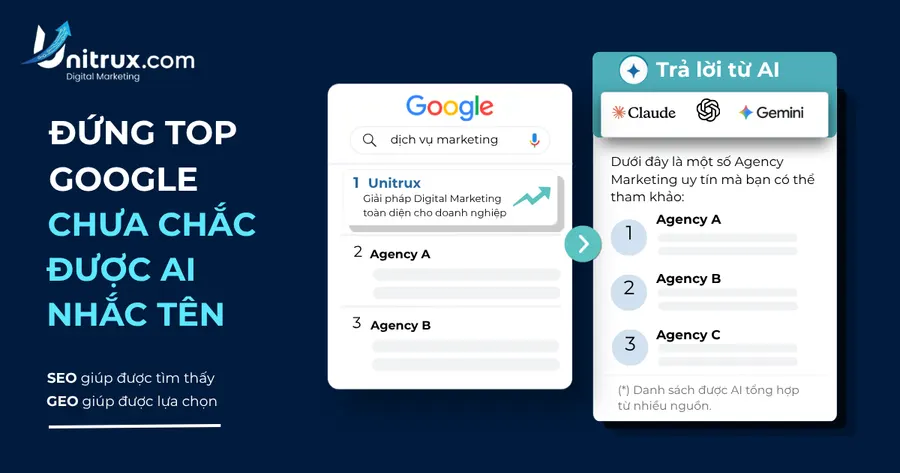
What is AEO? AEO (Answer Engine Optimization) is the practice of writing and structuring content so that Google AI Overviews, ChatGPT and Perplexity can understand it, extract it and use it as a direct answer to a user's question. The goal of AEO is to be chosen as the answer, not just to rank.
When customers in Vietnam ask "how much does a website cost" or "is a Facebook page chatbot worth it", more and more of them get the answer directly on the results page or inside an AI chat window. If your content is not chosen, your brand is almost invisible at the very moment customers are deciding.
Why should businesses care about AEO?
Search behaviour is shifting. Two milestones stand out:
- In February 2024, Gartner predicted that traditional search engine volume would drop 25% by 2026 as users move to AI chatbots and virtual agents.
- In May 2025, Google said AI Overviews were available in more than 200 countries and territories and over 40 languages.
This does not mean SEO is over. AI still needs trustworthy sources to build its answers, and those sources are usually well-indexed pages. AEO is an extra optimisation layer that makes your content easier to cite.
How do AEO, SEO and GEO differ?
| Criterion | SEO | AEO | GEO |
|---|---|---|---|
| Goal | Rank high on the results page | Be chosen as the direct answer | Be mentioned and cited by generative AI |
| Unit of optimisation | The whole page | Each answer passage, each question | Brand entity, source credibility |
| Main signals | Keywords, links, technical health | Short, clear, structured answers | Data, citations, brand mentions |
| Measurement | Rankings, clicks | Appearing in snippets and AI Overviews | How often AI mentions you |
The three approaches complement each other. To go deeper on GEO, read our article on the differences between GEO and SEO.
6 steps to AEO for a business website
Understanding what AEO is is only the first step; what matters is applying it page by page. Here is a 6-step process a small business can start on its own.
Step 1: Collect real customer questions
The best source is not a keyword tool but your Facebook page messages, Zalo chats, emails and sales notes. Gather recurring questions, group them by topic and prioritise those that come right before a buying decision.
Step 2: Answer directly in the first 40–60 words
Each article or section should open with a direct answer, then explain in detail. The "answer first, explain later" structure helps AI extract the right point without having to summarise.
Step 3: Use question-style headings
Write H2 and H3 headings the way customers ask: "Can the AI chatbot hand over to a staff member?" rather than "Handover feature". Question headings make it easier for engines to match content with queries.
Step 4: Use lists, tables and definitions
AI extracts structured information more easily. Use:
- A definition sentence in the form "X is…" for the main concept
- Numbered lists for processes
- Tables for comparisons, prices and specifications
Step 5: Add structured data (schema)
Article, Organization, FAQPage, Product or LocalBusiness schema helps machines understand who and what your page is about. Note that since August 2023 Google shows FAQ rich results only for some well-known government and health websites, but schema still helps machines understand your content.
Step 6: Strengthen credibility (E-E-A-T)
State the author, real-world experience, update date and references clearly. Content with verifiable data and consistent brand mentions gives AI more confidence to cite it.
How do you know whether AI is citing your content?
No tool measures this completely yet. Businesses can combine:
- Tracking important queries in Google Search Console, watching for rising impressions without rising clicks.
- Regularly asking ChatGPT, Perplexity and Gemini your industry's key questions and noting which brands are mentioned.
- Asking new customers "How did you hear about us?" and recording "from AI" answers.
At Unitrux, our internal editorial process scores every article across SEO, AEO and GEO before publishing, so each piece serves readers and is easy for machines to understand. To apply this to your own website, see our SEO/AEO/GEO service.
Frequently asked questions about AEO
What is AEO in one sentence?
AEO is presenting content so that answer engines and AI can take the right passage from your page as the answer to a user's question.
Does AEO replace SEO?
No. AEO builds on SEO. A page that is not indexed or loads slowly is unlikely to be chosen as a source by AI, however well it is written.
Do small businesses need AEO?
Yes, and they often have an advantage. Small businesses understand local customers' questions very well, so they can write more specific answers than generic aggregator sites.
How long does AEO take to show results?
Usually from a few weeks to a few months, depending on how quickly Google crawls the site, the level of competition and the site's existing authority.
Do I need to rewrite all my old articles?
No. Start with the 5–10 pages with the most impressions: add an opening answer, turn headings into questions and add a frequently asked questions section.
Đội ngũ Digital Marketing Unitrux · Nội dung được biên tập theo tiêu chuẩn nội dung hữu ích và đáng tin cậy của Unitrux.