
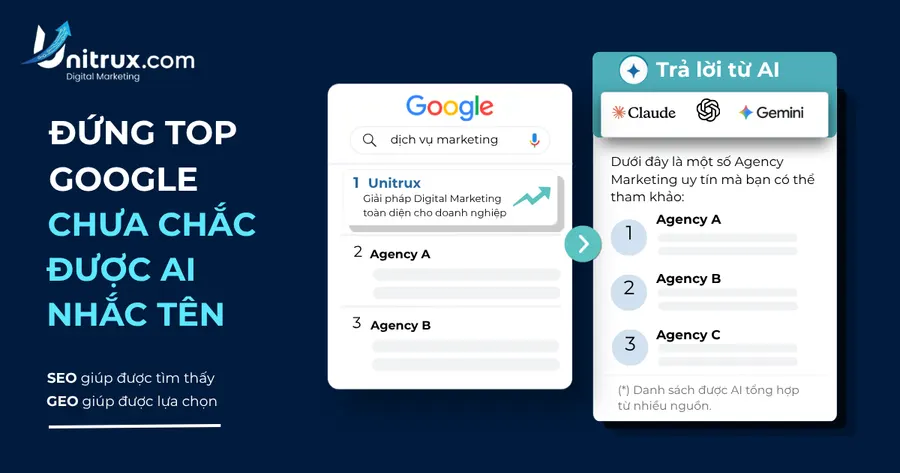
What is GEO?
GEO (Generative Engine Optimization) is the process of optimizing content so that generative AI tools — ChatGPT, Gemini, Perplexity, Google AI Overviews, AI Mode — can retrieve it, understand its context correctly, and cite it when synthesizing answers for users.
This isn't a fleeting marketing trend. The concept was first formalized in a paper published on arXiv in November 2023, authored by a research team from Princeton, Georgia Tech, the Allen Institute for AI, and IIT Delhi. The team analyzed roughly 10,000 real-world queries and found that content featuring credible source citations, specific statistics, and expert quotes could increase its likelihood of being cited by generative engines by up to 40%.
The context that makes GEO urgent is also reflected clearly in the data: according to Similarweb (July 2025), the zero-click search rate rose from 56% to nearly 69% in just one year after Google AI Overviews became widely available. In Vietnam, the e-Conomy SEA 2025 report found that 81% of users interact with AI daily — the highest rate in Southeast Asia.
What is SEO?
SEO (Search Engine Optimization) is the process of optimizing a website — across content, technical performance, and authority — to help it rank higher on search engine results pages (SERPs) like Google or Bing, thereby driving organic traffic without paying for ads.
An SEO strategy typically rests on three pillars: on-page SEO (keyword optimization, titles, meta tags, content structure), off-page SEO (backlink building, brand authority), and technical SEO (page speed, crawlability, structured data, mobile experience). SEO has existed and evolved for more than two decades, becoming an indispensable foundation of any digital marketing strategy — and it still plays a core role today, since most generative AI models tend to re-read content that Google has already ranked highly under the E-E-A-T standard.
So where do GEO and SEO differ?
SEO and GEO aren't competing strategies — they run on two different mechanisms while both relying on the same foundation: quality content.
On goals
Traditional SEO aims to rank high on the SERP
The ultimate goal of SEO is to get a website into the top search results, where users still have to click to view the content.
GEO aims to be cited within an AI-generated answer
With GEO, "winning" is no longer about holding the #1 spot on the SERP — it's about being selected by AI to appear in its synthesized answer, where users absorb information directly without clicking into any page.
On the unit of optimization
SEO optimization revolves around keywords and backlinks
These remain the two familiar pillars: choosing the right target keywords and building a link profile that points back to the site to boost its authority.
GEO optimization revolves around entities and trustworthiness
Rather than focusing purely on keywords, GEO is concerned with whether AI correctly recognizes you as a specific "entity," and whether it trusts you enough to cite your information.
On the primary signals
SEO relies on domain authority, page speed, and on-page optimization
These are the classic technical signals that help search engines evaluate and rank a page.
GEO relies on structured data and co-citation across multiple sources
The more independent, authoritative sources that mention the same piece of information, the stronger the basis AI has to trust and reuse that information in its answers.
On how success is measured
SEO is measured by rankings, organic traffic, and click-through rate (CTR)
These are familiar metrics, easily tracked through tools like Google Search Console or Google Analytics.
GEO is measured by citation frequency and the accuracy of brand mentions
GEO's metrics are far harder to capture, since most traditional analytics tools weren't built to track whether a brand is being mentioned inaccurately by AI.
On query behavior
With SEO, users tend to type short keywords
For example: "cheap laptop," "SEO services near me."
With GEO, users ask full, conversational questions
For example: "Which laptop should I get for graphic design work on a $800 budget?" — reflecting how people naturally converse with AI.
A key point worth noting: most AI models still tend to re-read content that Google has already ranked highly under the E-E-A-T standard (Experience, Expertise, Authoritativeness, Trust). This means a solid SEO foundation remains a prerequisite for GEO to work effectively. Experts increasingly agree that SEO, AEO (Answer Engine Optimization), and GEO should be viewed as three layers of a single content strategy, not three separate paths.
It's also worth keeping perspective: according to BrightEdge, AI search currently still accounts for less than 1% of total global referral traffic, while Google still holds over 90% market share. SEO is far from "dead" — but Gartner forecasts that traditional search volume could decline by roughly 25% by 2026 due to the rise of AI search, which is reason enough for businesses to act now rather than wait.
GEO is not just an llms.txt trick
This is one of the most common misconceptions today — many businesses believe that simply creating an llms.txt file completes their GEO strategy. In reality, it's far more complex than that.
What is llms.txt?
It's a text file placed at a website's root directory, acting as a directional summary that helps large language models quickly grasp key content, instead of having to crawl through complex HTML full of menus, ads, and scripts.
However, it remains only a proposed standard that major AI companies have not officially confirmed using. John Mueller, Google's Search Advocate, once wrote on Bluesky that no AI system currently uses llms.txt for crawling, and at one point compared it to the meta keywords tag — a signal once expected to matter a great deal but that has since lost almost all practical effect on rankings. OpenAI, Google, and Anthropic have yet to publicly confirm using this file when collecting web data.
That doesn't mean llms.txt is worthless. For SaaS websites, API documentation, or technical docs, the file can still be useful, since AI coding assistants often reference it to provide more accurate suggestions. Some reports indicate Google has indexed roughly 30,000–60,000 llms.txt files globally — though a rising count doesn't necessarily mean it determines whether content gets cited by AI.
Fundamentally, llms.txt is a directional layer sitting on top of an E-E-A-T foundation — it doesn't replace quality content. If the underlying content is thin, lacks evidence, or is written purely to stuff keywords, llms.txt will only help AI read a piece of content that isn't good enough to be cited any faster. This is precisely why GEO is not just an llms.txt trick — it's a system built on entity SEO, structured data, brand trustworthiness, and substantiated content.
7 mistakes that cause businesses to lose data when measuring GEO
- AI Overviews get lumped into Organic Search in GA4, making it nearly impossible to separate SEO performance from GEO performance without a dedicated setup.
- Referrer data is lost when users arrive via mobile AI apps, forcing the system to log the visit as "Direct traffic" instead of attributing it to the correct AI source.
- New AI tools aren't automatically recognized, causing their traffic to be dumped into a generic Referral or Direct bucket.
- Missing UTM tags on key content, leaving businesses unable to identify which pages are actually being cited by AI.
- HTTPS-to-HTTP redirects strip referral data, due to inconsistent SSL implementation across the site.
- Failing to separate branded and non-branded traffic, leading to a skewed assessment of both SEO and GEO performance.
- Overlooking the brand mention metric — the frequency and accuracy with which AI mentions a brand even when users don't click — a value that traditional traffic analytics tools simply cannot measure.
A comprehensive GEO optimization strategy
To execute GEO effectively, businesses need to combine several efforts: building consistent entity SEO across every platform, implementing structured data (Organization, FAQPage, Article schema) so AI can extract accurate information, writing content that answers questions directly upfront in the spirit of AEO, actively building co-citation from multiple independent, authoritative sources, and thoroughly fixing the seven measurement errors above before evaluating the strategy's real effectiveness.
Ready to get your brand into AI's answers?
If your business isn't sure whether its content is being cited by AI Overviews, ChatGPT, or Perplexity, our team can help audit your AI visibility, fix data measurement gaps, and build an integrated SEO – GEO – AEO strategy.
Contact Unitrux today to receive an assessment of how ready your website is for the AI search era.
Đội ngũ Unitrux · Nội dung được biên tập theo tiêu chuẩn nội dung hữu ích và đáng tin cậy của Unitrux.