
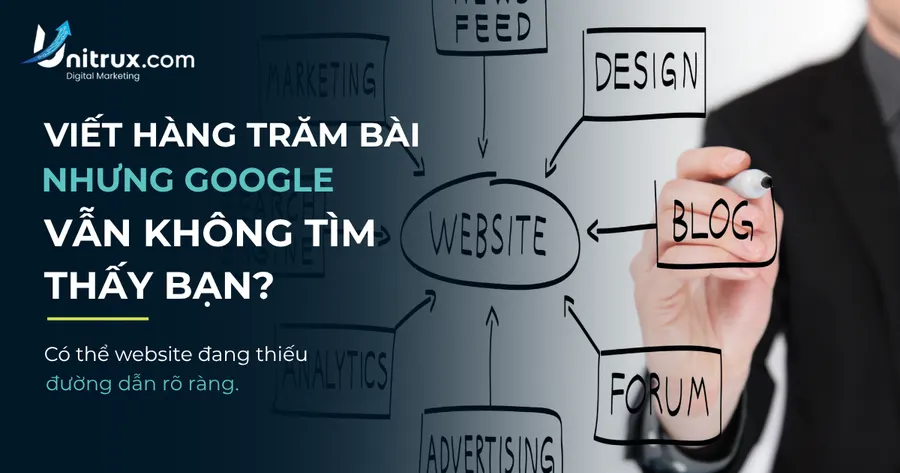
When a business approaches a website agency, the first question is almost always "how fast can we rank on Google?" The better question is: "is the technical foundation of our website actually solid?" Every content campaign, every ad dollar, every link-building effort eventually pours into the same funnel — and if that funnel is leaking from broken URL structure and internal linking, no amount of traffic poured in will stay.
What Is URL Structure?
URL structure is simply how you organize and name the address of every page on your website — the folder hierarchy, the page naming convention, and how content levels are reflected directly in the link itself.
Take a shoe store as an example:
- Messy structure:
unitrux.vn/index.php?id=284&cat=12&sub=7 - Clean structure:
unitrux.vn/running-shoes/mens-running-shoes
Both lead to the same page, but the second one tells the reader — and Google — exactly what it is: a page under "running shoes," specifically about "men's running shoes." A well-built URL works like a mini map. Just by glancing at the link, a visitor already knows where they are inside your website, without needing to click through first.
At its core, URL structure mirrors how you organize content: homepage → main category → subcategory → detail page. The more logical and consistent that hierarchy is, the easier it becomes for both users and search engines to "read" your entire site at a glance.
What Is an Internal Link?
An internal link is a hyperlink that connects one page to another within the same website — as opposed to an external link, which points from your site out to a completely different domain.
For example: inside a blog post about "how to choose running shoes," you add a link to your "men's running shoes" category page. That's an internal link. It can show up in several forms — top navigation menus, breadcrumbs, in-content links, or "related articles" blocks at the bottom of a page.
Internal links do three jobs at once: they help visitors move smoothly between related pages, they help Googlebot crawl and discover new pages, and they help distribute ranking strength — often called link equity — from your strongest pages toward the ones that need a boost. In short, if URL structure is the frame of a house, internal linking is the hallway and staircase system connecting every room.
Does URL Structure Really Affect Rankings, or Is That Just SEO Folklore?
It does — just not in the "shorter automatically wins" way people assume. Backlinko analyzed roughly 11.8 million Google search results and found that first-page URLs average around 66 characters, with position #1 URLs running about 9 characters shorter than position #10. A separate independent study of over 27,000 SERP results found a similar pattern, though the real-world effect shrank considerably once confounding factors were controlled for — in other words, URL length is a minor signal, not a silver bullet.
So why optimize it at all? Because short, meaningful URLs tend to come bundled with three things that matter far more: a higher click-through rate, faster comprehension by Google of what the page is about, and a clean hierarchy that concentrates a site's authority instead of spreading it thin across dozens of nested folders.
The Real Power of Internal Linking, Backed by Data
Zyppy ran a large-scale study analyzing roughly 23 million internal links across 1,800 websites and over 520,000 URLs. The findings: pages receiving 40-44 internal links generated roughly 4x more organic traffic than pages left with only a handful of links pointing to them. The same study uncovered something equally telling — pages using exact-match anchor text saw about 5x more traffic than pages relying on generic phrases like "click here" or "read more."
A separate study from JetOctopus found that optimizing internal link structure improved Google's crawl rate from around 40% to 70%. For websites with thousands of pages, that's the difference between new content getting indexed within days versus sitting invisible for months.
And yet, reality tends to be less flattering: Ahrefs data shows that 66.2% of pages across the web currently receive exactly one internal link. Meaning most content out there is effectively orphaned inside its own house.
Why URL Structure and Internal Linking Always Have to Work Together
URL structure is the frame — it defines which page belongs to which group, and how the hierarchy is organized. Internal linking is the bloodstream — it decides where authority and attention actually flow within that frame. A frame without bloodstream leaves pages standing but isolated. Bloodstream flowing through a messy frame leaves SEO strength scattered, circling without ever reaching its destination.
Here's a number worth sitting with: an Ahrefs analysis of roughly 1.1 billion web pages found that 95.2% of content on the internet receives zero external backlinks. For most websites — especially small and mid-sized businesses — quality backlinks aren't something you can simply acquire on demand. The one thing you fully control from day one is your own URL structure and internal linking.
User Experience Usually Decides Conversions Too
An experienced website agency doesn't treat technical SEO and website UX as separate disciplines. The reason is practical: users don't care how well you optimized your heading tags if they have to click through five or six pages just to find the service they need. Research from Google/SOASTA found that as the number of elements on a page (text, titles, images) grows from 400 to 6,000, the probability of conversion drops by as much as 95%. The messier and more complex a page gets, the more likely a visitor abandons it before ever reaching the contact button.
This is exactly where CRO (conversion rate optimization) and technical SEO meet. A clear URL structure helps users know where they stand on your site. A sensible internal linking system guides them to the right "contact us" or "get a quote" page at exactly the moment they're ready — instead of leaving them to wander off and give up.
Mobile Design: Where Every Mistake Shows Up First
In Vietnam, DataReportal's Digital 2026 report puts active mobile connections at 137 million — equivalent to 134% of the population — with internet users reaching 85.6 million. That means most of your potential customers are browsing with a thumb, on a few inches of screen, often while commuting or killing a few spare minutes. A confusing navigation menu, a URL structure that doesn't reflect real categories, or a page that takes more than 3 seconds to load — all of these are traps that push visitors away before they finish reading the first line. Page-speed research consistently shows that more than half of mobile users abandon a page if it takes longer than 3 seconds to appear.
That's why, when a website agency handles mobile design, they're not just making things look good on a phone screen — they're redesigning the entire URL structure and internal linking flow to match the fast scroll-tap-bounce habits of mobile users.
A Quick Checklist for a Professional Website Agency
- Does your URL structure reflect actual product/service categories, or is it still running on random IDs?
- Are your pillar pages (core services, flagship products) receiving enough internal links from blog posts and supporting pages?
- How many pages on your site are currently "orphaned" — not linked to from anywhere else?
- Does your mobile load time stay under 3 seconds, meeting Google's Core Web Vitals thresholds?
- How many clicks does it take to go from your homepage to a page with a call-to-action?
If you can't answer any of these with confidence, that's a sign to revisit your foundational strategy before pouring more budget into ads or content.
Conclusion: Strategy First, Tools Second
No SEO tool — no matter how expensive — can fix a strategy that's broken at the root. URL structure and internal linking aren't technical afterthoughts to tidy up later; they're the blueprint that needs to be drawn before the first line of content is even written.
Looking for a website agency that understands both technical SEO and real-world user experience? Unitrux builds websites from the ground up — URL structure, internal linking, page speed, and mobile-first design — so every visit has a real shot at becoming a customer. Contact Unitrux today for a full assessment of your website.
Đội ngũ Unitrux · Nội dung được biên tập theo tiêu chuẩn nội dung hữu ích và đáng tin cậy của Unitrux.